Weeping and bleeding statues
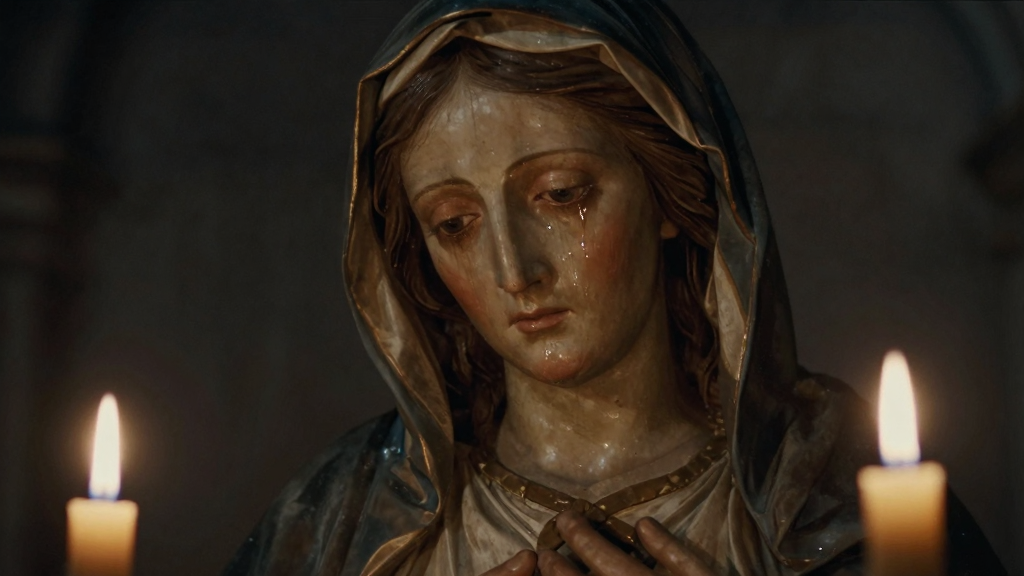
A plaster Madonna on a bedroom wall, a wooden statue in a parish, a painted icon behind glass — and then the reports: a bead of moisture at the eye, a red streak down the cheek, a cloth pressed to the face that comes away wet. Word spreads, crowds gather, and a local bishop or a laboratory is asked the question the crowd is already answering for itself. The registry holds these reports across decades and continents.
Most never move past the report itself. A large share are searched hard and still cannot be independently pinned down, and only rarely do enough unrelated sources converge on the same event for the registry to call its circumstances corroborated — which, here more than anywhere, is not the same as calling a miracle real.
What the category is
A weeping-or-bleeding-object report is an account that an inanimate religious image — a statue, icon or painting — has produced tears, blood, oil or other fluid. Lightf1ow catalogues the reports: what was seen, who saw it, where and when, and how far the account traces through parish records, press and any examination. It takes no position on the cause.
The load-bearing distinction here is sharp. 'Verified' on Lightf1ow means only that independent sources agree the event was reported and investigated as described — the crowd, the bishop's inquiry, the lab result. It never means the fluid was miraculous. A case can be fully verified as an event and still have an entirely natural or fraudulent explanation.
The moments that made the record
The Weeping Madonna of Syracuse, Sicily, 1953. A cheap mass-produced plaster plaque of the Immaculate Heart of Mary, hanging over a newlywed couple's bed, was reported to shed tears over several days. The case drew enormous crowds and a swift local Church inquiry, and became the modern template for the phenomenon — an ordinary household object, ordinary people, and a claim that outran everyone involved.
Our Lady of Akita, Japan, 1975. A wooden statue of the Virgin Mary in a convent in Akita was reported to weep on many occasions over several years. It matters as a landmark because it was investigated by the local bishop, who eventually permitted devotion, and because the reported tears were said to have been examined — a case where the institution engaged rather than dismissed.
Civitavecchia, Italy, 1995. A small statue of the Madonna was said to weep blood. When a sample was tested it returned a male DNA profile, which cut directly against a miracle and fuelled a fraud debate, since a statue cannot itself carry human blood — yet no charge was ever proven. It is the case both camps cite: believers for the intensity of the reports, sceptics for the plain forensic problem.
The reporting shape is distinctive: a specific object in a specific place, a burst of local witnesses, and often a formal inquiry — which is why this category traces further than pure eyewitness phenomena, without that ever amounting to proof of the miraculous.
Why this is contested
Every camp, fairly stated; a side for none. This is the chapter only a registry can write — we are the one place that does not need anyone to win.
The sceptics' account
Sceptics point to well-understood mechanisms: capillary action drawing oil or condensation through porous plaster, glaze that beads moisture, applied oils, and a documented history of outright hoaxes. Where a fluid tests as human blood on an object that cannot produce it, they argue the natural reading — that a person put it there — is the parsimonious one.
The witnesses' and believers' account
Witnesses describe repeated, close-range observation before crowds, sometimes over days, and note that many objects are cheap and unremarkable with no obvious means or motive for fraud. Believers add that some cases survived Church scrutiny by cautious investigators who had every reason to dismiss them.
Where the Church and forensics stand
The Catholic Church investigates such claims slowly and approves very few, treating most as unproven; forensic testing, where allowed, has resolved some cases as natural or fraudulent and left others simply unexamined because samples were never released. Neither institution treats a wet statue as evidence of the supernatural.
What the registry can honestly say
The registry records the reports and how far they trace. A verified case here means unrelated sources agree on what happened and was investigated — never that the tears were miraculous. It promises no miracle and forecloses none.
The registry, live right now
The evidence, honestly
Weeping and bleeding objects sit mostly in reported, with a substantial tail that is searched but left unverifiable, and only a single case in our data that reaches verified. That shape follows from the phenomenon: it is tied to a fixed object and a crowd, so many accounts attract press and inquiry — but the fluid is usually gone, untested, or never released for testing, which strands the account short of independent corroboration.
This is a picture of the evidence, not a verdict on the witnesses. The lone verified case says only that its circumstances were independently confirmed as reported and examined; it makes no claim about cause. The large unverifiable tail is exactly what an honest registry looks like when many events are real as events yet impossible to nail down after the fact.
Cases worth retelling
Every report on the radar
The same cards, gates and honesty invariants as the main flow — filtered to weeping and bleeding statues.
Browse all 55 on the radar →Questions people ask
Have weeping statues ever been proven fake?
Why do so few of these reach verified?
Does a verified case mean the tears were a miracle?
Explore the other categories on the radar
Lightf1ow tracks 16 categories of reported anomaly, each measured the same honest way.
Further reading
- Encyclopaedia Britannica — 'weeping statue' ↗ — a neutral overview of the phenomenon and the natural explanations proposed for it